



By Jack Dell’Accio, Certified Sleep Coach, CEO & Founder of Essentia
For years, the conversation around better sleep has centered on sleep hygiene: bedtimes, routines, screen limits, caffeine cutoffs. These habits matter. But they are often treated as the starting point, when in reality they should come after something far more fundamental.
That foundation is your sleep environment.
If sleep hygiene is the routine, the sleep environment is the arena. And if that arena is chemically, physically, or biologically stimulating, your nervous system will never fully power down, no matter how perfect your habits look on paper.
In my work as a Certified Sleep Coach and through decades of developing sleep systems, I’ve learned this simple truth:
Your nervous system does not negotiate with stimulants while you sleep. It reacts to them.
Let’s break down why sleep environment comes first and how sleep hygiene only works once the environment is under control.
What Is Sleep Hygiene?
Sleep hygiene refers to the behaviors and routines that support sleep consistency and predictability. These include:
-
Maintaining a consistent sleep schedule: going to bed and waking up at the same time each day
-
Create a relaxing bedtime routine
-
Avoiding intense workouts late at night
-
Be mindful of food and drink
-
Change bad habits: limit naps, limit screen time before bed etc.
These habits help your brain anticipate sleep and prepare for it hormonally and neurologically. When applied correctly, sleep hygiene can support healthy sleep.
But support is the keyword.
Sleep hygiene does not override stimulation coming from your environment.
What Is Sleep Environment?
Your sleep environment is everything your body is exposed to while you sleep, the inputs that interact directly with your nervous system for six to eight hours a night.
This includes:
-
Your mattress and sleep surface
-
Air quality and chemical exposure
-
Allergens and immune triggers
-
Temperature and humidity
-
Pressure points and pain signals
-
Mold and microbial growth
These factors don’t require conscious awareness to affect you. They operate beneath perception, constantly feeding signals to the brain.
When the environment is stimulating, your body stays alert, even while you’re unconscious.
Why Sleep Environment Comes First
When people struggle with sleep, they often say:
“I do everything right, but I still don’t feel rested.”
In most cases, the missing piece is environmental stimulation.

1. Chemical Stimulation: Toxins and the Central Nervous System
One of the most overlooked disruptors of sleep is chemical exposure, especially from the mattress.
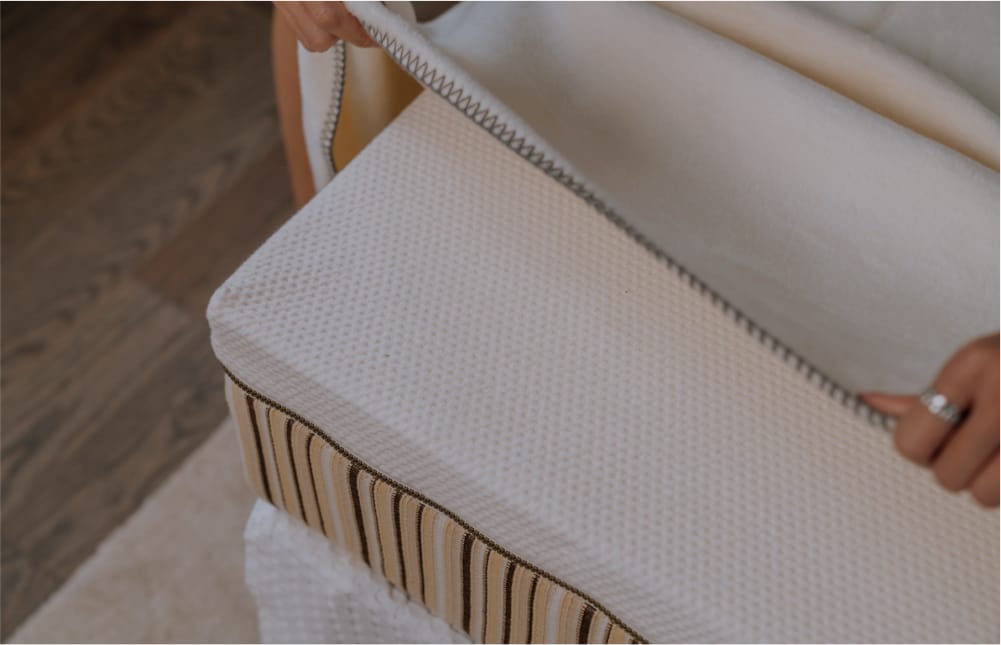
Most conventional mattresses contain synthetic foams, flame retardants, adhesives, and chemical treatments that continuously off-gas volatile organic compounds (VOCs). Your skin, the body’s largest organ, is in direct contact with these materials for hours every night.
These toxins act as low-grade stimulants to the central nervous system. Instead of slowing down, the nervous system remains in a state of vigilance.
Certified Organic materials matter because they remove this chemical noise. When toxins are eliminated, the brain finally receives the signal that it is safe to let go.
This is why, at Essentia, the sleep environment is something we are always considering, using only certified organic components to engineer our organic mattresses to minimize nervous system stimulation.
2. Allergens: Immune Activation Is Stimulation
Allergens don’t just affect breathing or cause sneezing; they activate the nervous system.
Dust mites are a primary source of allergen stimulation, and they don’t just exist in the abstract; they live and thrive inside mattresses. Cotton and wool batting, quilted fibers, and padded upholstery create ideal nesting environments where dust mites feed on shed skin cells, reproduce, and leave behind allergenic waste. Traditional innerspring mattresses add another layer of risk: movement within the coil system accelerates the breakdown of surrounding materials, increasing microdust circulation inside the bed. Untreated latex proteins and residual detergents in natural fibers can further compound immune activation. Even when symptoms aren’t obvious, this constant exposure increases neurological activity and keeps the body in a defensive, alert state.
An activated immune system is not a resting system.
When your mattress harbors allergens, your body spends the night defending instead of repairing. This is precisely why, at Essentia, we design mattresses without cotton or wool batting, quilted fibers, or other materials that allow dust mites to nest and proliferate. By eliminating these allergen-prone components and focusing on engineered, breathable organic foams, we reduce immune activation at its source. The result is an environment that allows sustained REM and Deep Sleep, the stages responsible for cognitive recovery, hormonal balance, and cellular repair, to occur naturally and consistently.
This approach is supported by allergen testing conducted with the Johns Hopkins School of Medicine, which confirmed Essentia mattresses as resistant to dust mite habitation and allergen buildup, earning recognition as a truly dust mite resistant mattress designed to reduce immune and nervous system stimulation at the source.
3. Mold: The Silent Saboteur
Mold is one of the most underestimated sleep disruptors. It thrives in warm, humid environments within the home and can colonize a wide range of surfaces when moisture and airflow are not properly managed.
Mold spores act as chronic stressors to the immune and nervous systems. Exposure has been linked to:
-
Fatigue and brain fog
-
Respiratory stress
-
Inflammation
-
Fragmented sleep cycles
A sleep sanctuary cannot exist in the presence of mold. Managing humidity, airflow, and choosing materials that resist microbial growth is critical to restorative sleep.
Over the last several years, I’ve spent a significant amount of time researching how mold pressure within the home impacts sleep quality and recovery. What became clear through this work is that once mold is present in the environment, material choice matters. Certain surfaces allow mold spores to anchor, spread, and persist, while others actively resist colonization. This research led us to develop Essentia’s high-acidity foam formulations, engineered to create an inhospitable environment for mold growth. By incorporating naturally high-acidity essential oils into our organic foams, we help protect the sleep surface from becoming a contributor to mold-related immune and nervous system stress, supporting a healthier sleep environment even when external mold pressures exist.
4. Pain and Pressure Points: Pain Is a Stimulant

Pain, whether sharp or subtle, is one of the strongest sleep disruptors.
A mattress that fails to redistribute pressure creates pain points that send constant signals to the brain. Even micro-adjustments throughout the night keep you in lighter stages of sleep.
Pain prevents the body from staying in Deep and REM sleep long enough to recover. This is why pressure redistribution, spinal alignment, and material consistency are foundational elements of the sleep environment.
Comfort alone is not enough. Support and pressure redistribution determine whether pain becomes a nightly stimulant.
This is exactly why I developed Essentia’s patented Beyond Latex® Organic Foam. Unlike conventional foams that either push back too aggressively or collapse under the body, Beyond Latex is engineered to work with the nervous system. Its slow-response, high-elasticity structure allows the body to fully settle, evenly redistributing weight to eliminate pressure points while maintaining consistent spinal alignment. By reducing mechanical stress and pain signals, Beyond Latex helps calm nervous system activity, allowing the body to remain in Deep and REM sleep long enough to complete true physical recovery. The foam is also inherently breathable and non-toxic, ensuring that pressure relief never comes at the expense of temperature regulation or chemical stimulation.
Sleep Hygiene: Powerful but Only After the Environment Is Right

Once the sleep environment is optimized, once chemical, biological, and physical stimulants are removed, sleep hygiene becomes a powerful amplifier.
Now, habits like:
-
Consistent bedtimes
-
Calming pre-sleep routines
-
Proper nutrition timing
-
Thoughtful caffeine use
Your brain can predict sleep. Your nervous system can slow down. Your body can remain in recovery mode long enough to complete full sleep cycles.
Without the right environment, sleep hygiene is like trying to meditate in a noisy room. With the right environment, those same habits feel effortless.
The Hierarchy of Restorative Sleep
If you truly want to extend your time in REM and Deep Sleep, follow this order:
-
Control the sleep environment
Remove chemical, allergen, mold, temperature, and pain-based stimulants. -
Stabilize nervous system input
Choose materials and systems that support slow nervous system activity. -
Layer in sleep hygiene
Build habits that reinforce what the environment already allows.
This is how you extend consistent time in REM and Deep Sleep, not just log more hours in bed.
Final Thoughts
Sleep hygiene is important. But it is not the foundation.
Your sleep environment is where stimulation is either eliminated or silently amplified. Until that foundation is solid, habits alone will always fall short.
When you remove the stimulants, the body remembers how to sleep.
Be Well,
Jack Dell’Accio
