




By Jack Dell’Accio, Certified Sleep Coach, CEO & Founder of Essentia
Most people believe the immune system works 24/7, and that sleep is simply downtime… a passive break from the day.
That belief about sleep is wrong.
Your immune system patrols (active defense & repair: During the day immune cells migrate into tissues, ready to engage into tissues ready to engage in protection and repair of damages) during the day, but it does not rebuild itself then. The real work, the kind that determines whether you get sick, stay inflamed, or recover properly, happens at night.
Sleep is not rest. Sleep is active, high-performance repair.
And without consistent access to the right stages of sleep, your immune system doesn’t just slow down, it loses its precision.
Here is how the nightly security shift actually works, and why your current sleep environment might be locking you out of the recovery you need.
The Immune System Runs a Two-Shift Operation
We need to stop treating sleep as one long, undifferentiated block of time. Biologically, immune recovery happens in two distinct shifts, each with a specific role.
Miss either one, and recovery breaks down.

Shift One: Deep Sleep - The Physical Training Camp
Deep sleep, also called slow-wave sleep, is the anabolic phase of the night. This is when growth hormone surges, not for aesthetics, but for repair and immune readiness.
That hormone signal pulls key immune cells, especially T-cells, out of the bloodstream and into the lymph nodes.
This matters because lymph nodes are not passive storage sites. They are training facilities. This is where your immune system consolidates immunological memory—where it learns how to recognize and respond more efficiently the next time it encounters a virus.
Deep sleep is where tissue repair happens at the cellular level. It’s where inflammation is regulated, damage is fixed, and the physical foundation of immunity is rebuilt.
No deep sleep, no real repair.
Shift Two: REM Sleep - The Regulatory Reset
Later in the night, we move into REM sleep. This is where immune function becomes intelligent.
REM is unique because it is the only time your adult brain is essentially free of norepinephrine, the chemical driver of adrenaline and stress. This neurochemical silence is not a luxury. It is a requirement.
This is the moment your nervous system finally exits fight-or-flight and re-enters regulation. Inflammatory signaling is balanced. Stress hormones are lowered. The system relearns how to stand down.
Without REM, the immune system becomes reactive instead of precise.
What the Immune System Can Only Do During Sleep
When we look at what actually happens during these stages, three critical functions stand out, none of which occur properly when sleep is fragmented.
1. Immune Communication
During sleep, the body releases cytokines, messenger proteins that coordinate immune responses. Without adequate sleep, immune cells struggle to communicate, delaying and weakening your response to infection.
2. Target Engagement
For T-cells to destroy infected cells, they must physically bind to them. Sleep activates integrins, the proteins that give immune cells their grip. Elevated stress hormones, common with poor sleep, reduce this adhesion. Your immune cells quite literally lose their ability to hold on.
3. First-Line Defense Strength
Even a single night of 4–5 hours of sleep can reduce Natural Killer (NK) cell activity by up to 70%. These cells are your front-line defense against viruses and abnormal cells. This isn’t cumulative damage; it happens fast.
That’s why sleep is a force multiplier.

One study found that individuals sleeping fewer than six hours after a Hepatitis B vaccination were 11.5 times more likely to remain unprotected than those sleeping seven hours or more.
Weaker, Louder, and More Reactive: Your Immune System When Lacking Quality Sleep
So, what happens when you cut these stages short? What happens when your sleep is fragmented and you don't get that time in REM and Deep Sleep?
When Deep sleep or REM sleep is shortened or disrupted, the immune system doesn’t simply weaken; it destabilizes.
Inflammation stays elevated. Signals fire indiscriminately. Energy is wasted. Collateral damage increases.
This is why people with poor sleep wake up inflamed, foggy, and slow to recover. You don’t want an immune system that reacts to everything. You want one that responds accurately.
REM sleep provides that restraint. Deep sleep provides the rebuild.
Remove either, and precision is lost.
Why Catch-Up Sleep Doesn’t Work
You cannot bank sleep to repair immune damage later.
Consistency is the only metric that matters.
That 70% drop in NK cell activity doesn’t instantly rebound after a long weekend in bed. Immune recovery depends on nightly access to Deep and REM sleep; on rhythm, not rescue.
My pro tip as a Certified Sleep Coach:
If you feel a scratchy throat coming on, don’t reach for another supplement. Reach for your pillow. Go to bed one to two hours earlier. Give your night-shift cells the head start they need.
The Missing Link: Your Sleep Environment

This is where most sleep advice fails.
You can have perfect habits, wearing blue-light blockers, taking magnesium, meditating, and having a consistent bedtime. But if your sleep environment is stimulating your nervous system, those habits won’t matter.
Why? Because your nervous system does not negotiate during sleep. It reacts.
To access Deep and REM sleep, the brain must perceive safety. If there are stimulants present, your brain will remain in a state of subconscious vigilance, effectively blocking you from the deepest restorative stages.
At Essentia, we identify eight major sleep disruptors in the bedroom. Two are the most common for all sleepers and can account for the majority of immune-related sleep loss:
1. Chemical “Noise”
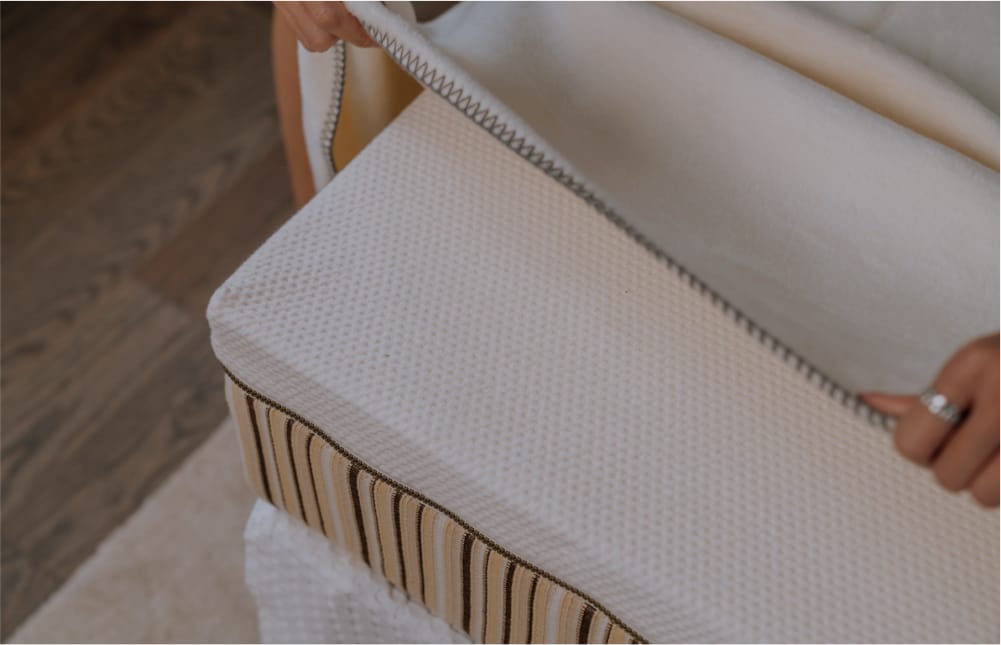
Most conventional mattresses are reservoirs of low-grade chemical stimulants: off-gassing foams, glues, flame retardants, and VOCs.
These are not just unpleasant smells. They are central nervous system irritants.
While you sleep, your body processes this chemical noise, preventing full neurological shutdown. Certified organic materials aren’t a lifestyle upgrade; they’re a physiological requirement for real recovery.
Not to mention, if you sleep hot and opt for a “cooling mattress,” that means you are exposed to even more chemicals. Chemical cooling relies on phase-change materials, chemistry embedded into fabrics or foams that react to initial contact with heat.
Remove the chemicals, and the brain can finally let go.
2. Physical Stimulation
Then there is the physical side.
If your mattress creates pressure points that cut off circulation, or if it lacks proper support, causing spinal misalignment, your body is forced to make constant micro-adjustments all night long.
Going back to chemical cooling, remember that the chemical cooling feeling is activated at initial contact with heat. You shift positions, the chemical reaction activates, you feel a brief cooling sensation… and then it fades.
So whether you are chasing cooling, tossing due to pins and needles, or just uncomfortable, every micro-movement is a micro-arousal.
Every toss and turn is a signal to your brain: Stay alert.
You are being physically kicked out of the Deep and REM stages before the work is finished.
Control the Environment First
If you want a resilient immune system, stop treating your bedroom like a furniture showroom and start treating it like a recovery chamber.
You will never achieve consistent immune repair if your environment is stimulating your nervous system, chemically or physically.
The hierarchy is simple: Control the environment first. Remove the stimulants. Then let the biology do its job.
You don’t sleep to rest.
You sleep to repair.
Be well,
Jack
